
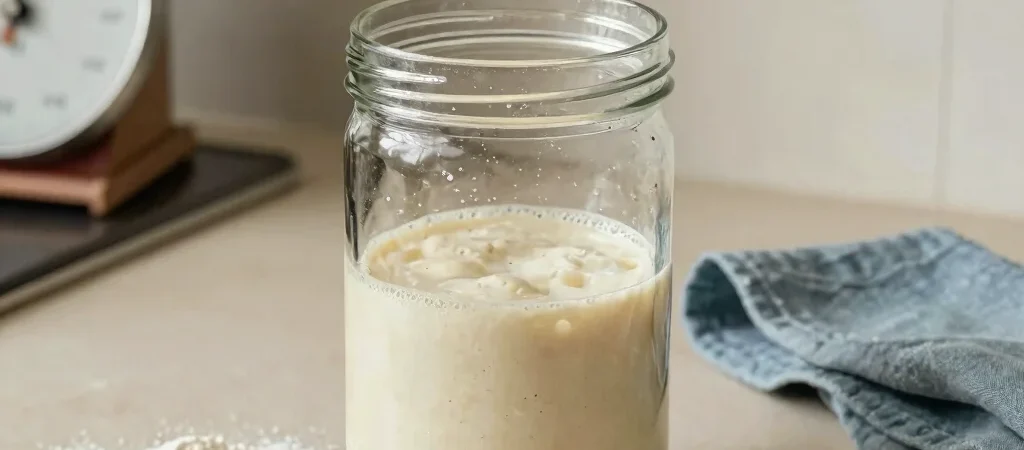
A new sourdough starter can look quiet for a day, then suddenly leave a streak high above its starting line. That variation is part of learning your kitchen, where temperature and flour affect how quickly the mixture changes. A scale and a simple record of what you fed it are more useful than trying to force it onto a fixed timetable.
Make the Routine Repeatable
Use a clean, straight-sided jar so you can see the rise, and mark the level after feeding. One simple maintenance approach is to keep 25 grams of starter and mix in 50 grams each of water and flour by weight; consistency makes it easier to compare one feeding with the next. Keep the jar covered but not tightly sealed, and follow a trusted recipe for the starter and bread you are making.
Read What You See
Bubbles and a rise after feeding are useful signs of activity, but the timing will vary with the warmth of the room and the flour in the jar. A straight-sided container makes the pattern easier to notice: mark the starting point, then check again rather than relying on memory. If you see mold or unusual colored growth, discard the starter rather than trying to salvage it.
Buy Only What Helps
A kitchen scale earns its space if you bake regularly, because weighing flour and water makes each feeding easier to repeat. Beyond that, a clean jar and an ordinary spoon are enough to begin; special lids and decorative crocks are choices, not requirements. If we recommend or link to a scale or other baking essential, we may earn a commission at no extra cost to you, and we aim to explain what the item does—and what you can do without.